-1.png?width=600&height=450&name=Untitled%20design%20(8)-1.png)


The Employment Rights Act 2025: what HR and Benefits teams need to get right in 2026
The Employment Rights Act 2025 is now law.
As legislation becomes clearer in 2026, the pressure for HR and benefits leaders will shift to ensuring their organisations can confidently stand behind decisions in real-life scenarios. Because that’s where scrutiny lands.
In absence.
Adjustments.
Performance conversations linked to health.
Menopause.
These are the moments where organisations are already feeling pressure and where risk builds quietly if support arrives too late or varies manager to manager.
What the Employment Rights Act changes for employers
The Act brings wide-ranging changes, with implementation phased across 2026 and 2027. These include expanded worker protections and easier access to employment tribunals.
In practical terms, this means employer decisions are more likely to be challenged and more closely examined.
When that happens, organisations are increasingly expected to show:
- that issues were picked up early
- that support was available and visible
- that similar situations were handled in broadly the same way
- and that managers weren’t left to make judgement calls alone
Having a policy is no longer enough. Employers need to show how decisions are made and applied in practice.

Where risk actually shows up
Most issues don’t start as formal grievances or claims.
They usually start with:
- repeated short-term absence
- someone underperforming because of a health issue they haven’t raised
- adjustments being delayed or handled differently across teams
- informal conversations that drag on without support
By the time HR is involved formally, situations are often already complicated.
Under the Employment Rights Act, delays and inconsistency are harder to defend, even where intentions are good.
Health at work is no longer a side issue
Health-related issues affect a large part of the workforce.
- The number of people economically inactive because of long-term sickness has risen to over 2.5 million people, an increase of over 400,000 since the start of the coronavirus pandemic.
- For those economically inactive because of long-term sickness, nearly two-fifths reported having five or more health conditions.
- In 2024, 11 million fit notes were issued in the UK.
- Work-related ill health affects around 1.9 million people.
These are everyday realities for most (if not all) organisations.
How organisations respond to health concerns, particularly timing and consistency is now a core people risk issue.
Why menopause matters so much
Menopause is one of the clearest examples of how this plays out.

It cuts across health, discrimination risk, absence and retention. It’s also an area where support is often delayed or handled informally.
Employment tribunal claims referencing menopause have more than tripled in recent years. At the same time, many women still don’t feel comfortable raising symptoms early at work.
With Menopause Action Plans now written into employment law and expected to become mandatory for large employers from 2027, many organisations are choosing to act earlier in 2026.
In practice, menopause has become a test of whether an organisation’s approach to health support really works.
What to focus on in 2026
Preparing for the Employment Rights Act doesn’t mean doing everything at once.
What matters is being able to show that your organisation:
- understands where risk sits
- has taken reasonable steps to prevent escalation
- and has a clear, proportionate plan
Based on where employers are most exposed, there are six areas HR and Benefits teams should focus on in 2026:
- knowing where health-related issues tend to escalate
- making support easy to access early
- reducing reliance on individual manager judgement
- intervening earlier to prevent long-term absence
- treating menopause as a priority area
- having a clear plan, even if everything isn’t in place yet
These steps help organisations move away from firefighting and towards more consistent, defensible decision-making.
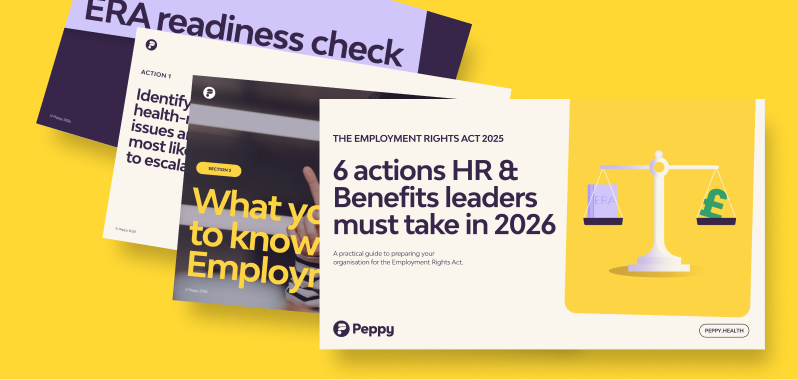
The Employment Rights Act 2025: 6 actions HR & Benefits leaders must take in 2026
Download the guide
Download the guide
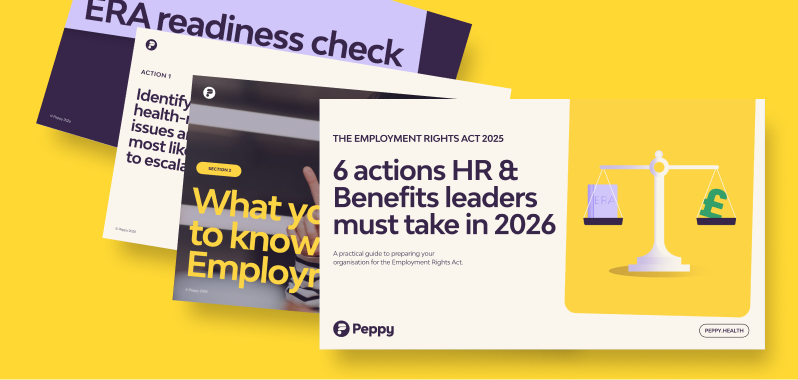
We’ve pulled all this and so much more into a practical guide for HR and Benefits leaders: The Employment Rights Act 2025: 6 actions HR & Benefits leaders must take in 2026
It’s designed to help you:
- see where risk really sits
- decide what to prioritise now
- and prepare for 2026 with clarity
Download the guide here!