-1.png?width=600&height=450&name=Untitled%20design%20(8)-1.png)


If you can't quantify the need, you can't fund the fix.
That's the reality for HR and benefits leaders trying to build a business case for neurodiversity support. Your board won't sign off on budget without data. Your CFO won't listen to good intentions.
But you don't need a six-month research project or an expensive consultancy. You need the right questions.
BNP Paribas proved it. They added a handful of targeted questions to their annual benefits survey and uncovered that 15% of employees identified as neurodivergent and 30% were caring for a neurodivergent child. That data built an undeniable business case and their programme went on to win the Best Neurodivergent Support Programme award.
Here's exactly what to ask, and why it works.
The three questions that build your business case
1. Identity and caring responsibilities
- Do you identify as neurodivergent? (diagnosed / self-identified / prefer not to say)
- Do you care for a neurodivergent family member? (yes / no / prefer not to say)
These two questions give you the scale of the challenge. Most HR leaders underestimate both numbers. Diagnosed neurodivergence is just the tip of the iceberg — self-identified employees and carers represent hidden retention risk, absence drivers, and talent you're about to lose if NHS waiting lists hit 3 to 5 years in your area.
2. Experience at work
- Do you feel supported at work around neurodiversity? (scale 1–10)
- Do you know where to go if you need support? (yes / no / unsure)
- How confident do you feel supporting a neurodivergent colleague? (scale 1–10)
- How confident do you feel supporting a neurodivergent direct report? (scale 1–10)
These questions expose the gap between policy and reality. You might have a neurodiversity policy, but if employees don't know it exists or managers don't feel confident using it, it's not working. These scores give you a baseline to measure against post-implementation.
3. Support gaps (the question that tells you where to invest)
What would make the biggest difference to you when it comes to neurodiversity support at work? (select up to 3)
- Knowing what support is available to me
- Feeling able to raise it openly at work
- Accessing a diagnosis route
- Getting the right adjustments in place
- Knowing where to turn after a diagnosis
- Having a manager who knows how to support me
- Understanding whether my experiences are neurodiversity-related
- Something else (please specify)
This is the question that builds your roadmap. If "accessing a diagnosis route" tops the list, you know where to focus. If "feeling able to raise it openly" dominates, you've got a culture problem to fix first. The answers tell you exactly where your budget needs to go.
Why this approach works
It's anonymous. Employees won't tell you the truth if they think HR will see their name next to "neurodivergent." BNP Paribas used an external provider to remove that barrier — response rates and honesty both went up.
It's fast. Add these questions to your next benefits survey or pulse check. You'll have actionable data within weeks, not months.
It builds your business case. When you walk into your CFO's office with "15% of our workforce is neurodivergent, 30% are carers, NHS waits are over 14 months, and only 37% feel supported," you've got a retention argument, an absence argument and a talent argument. That gets budget.
What to do with the results
Once you've run the survey, you'll know three things:
- The scale of the need (how many employees and carers are affected)
- The confidence gap (how supported employees feel, and how confident managers are)
- Where to invest first (diagnosis routes, manager training, culture work, post-diagnosis support)
That's your roadmap.
And once you know where the gaps are, you need somewhere credible to send employees. Platforms like Peppy give employees expert-led neurodiversity content, ADHD and autism screening questionnaires, and 1:1 Healthy Minds support — without requiring disclosure or internal complexity.
Get the full blueprint
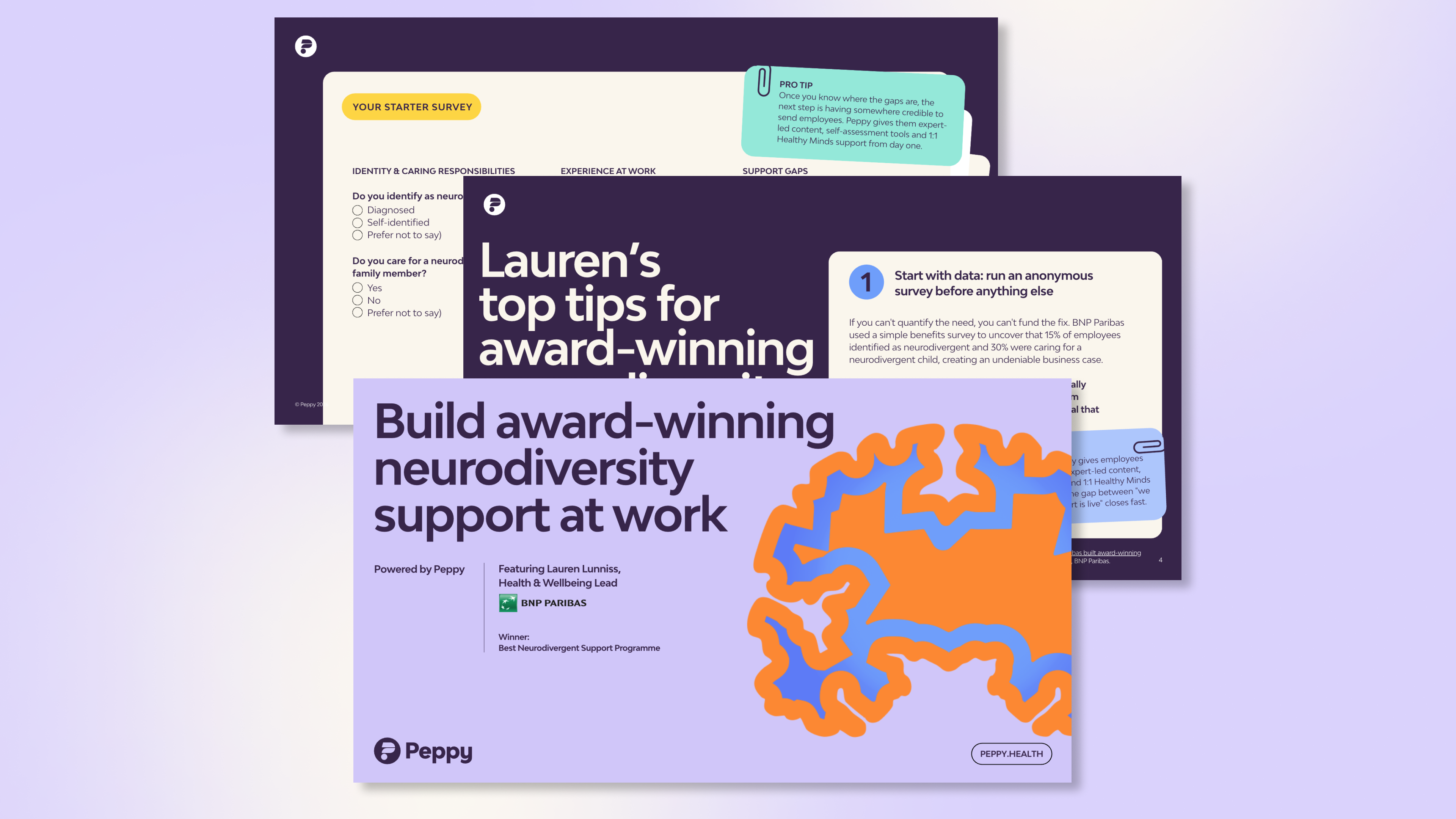
These survey questions are just the start. BNP Paribas used similar to build an award-winning neurodiversity programme and we've turned their full approach into a free guide for HR and benefits leaders.
Inside the guide:
- Lauren Lunniss's 5 top tips from BNP Paribas' award-winning programme
- The complete survey template (ready to copy into your next pulse check)
- How to build a clear end-to-end neurodiversity pathway
- How Peppy powers neurodiversity support at work
Download the free guide: Build award-winning neurodiversity support →

How Peppy fits into this
BNP Paribas uses Peppy as part of their award-winning programme.
Peppy's Neurodiversity Support gives employees:
- Expert-curated content on autism, ADHD, dyslexia, dyspraxia, OCD
- Self-screening questionnaires for ADHD and autism
- 1:1 support calls with qualified Healthy Minds practitioners
- Confidential access — no manager disclosure required
All within the Healthy Minds service, which also covers menopause, fertility, pregnancy and parenthood, men's health, and women's health.
If you're already thinking about neurodiversity as part of a broader health and wellbeing strategy, Peppy can help. We support employees across menopause, fertility, pregnancy and parenthood, men's health, women's health, and neurodiversity - all in one place.