-1.png?width=600&height=450&name=Untitled%20design%20(8)-1.png)


You've got a neurodiversity policy. Maybe you've run an awareness week.
But if you're honest, is it actually working?
Probably not. Employees don't know where to go. Managers are winging it. And the people who need help most won't ask for it.
BNP Paribas had the same problem. Then they fixed it and won the ‘Best Neurodivergent Support Programme’ award for it.
We sat down with Lauren Lunniss, Health & Wellbeing Lead at BNP Paribas - one of Peppy's clients - to find out what worked for them.
Step 1: Run a survey (it'll change everything)
Lauren didn't start with a vendor or a policy. She added some questions to their benefits survey.
Example questions they asked:
- Do you identify as neurodivergent?
- Do you care for a neurodivergent family member?
What came back:
- 15% of their workforce identified as neurodivergent
- 30% were caring for a neurodivergent child
- NHS waits were 12–24 months
That data built the business case.
"The longer the wait, the higher the risk of potentially losing talent and increasing things like absenteeism due to carers' leave." Lauren Lunniss
Your move: Add some neurodiversity related questions to your next benefits survey.
(They're in the free guide.)
Step 2: Don't stop at diagnosis
A lot of organisations fund a diagnostic pathway and then... nothing.
The employee gets their diagnosis and is told to "speak to your GP." Who has a 12-week wait. Who doesn't know much about adult ADHD. Who definitely can't help with workplace adjustments.
So BNP Paribas built a pathway:

- Diagnostic access (cutting NHS waits)
- Post-diagnosis support (therapy, occupational health, medication guidance)
- A central hub (so employees always knew what to do next), including giving access to Peppy’s neurodiversity support
"There's no point giving someone a diagnosis and then leaving them with nowhere to go." Lauren Lunniss
Your move: If you're funding diagnostics, audit what happens next. If the answer is "we signpost to the NHS," you've just added a step, not solved the problem.
See how Peppy's neurodiversity support works: Expert-led content, ADHD and autism screening questionnaires, and 1:1 Healthy Minds calls that give employees a clear pathway from awareness to action. Learn more →
Step 3: Give managers confidence (not a clinical handbook)
Your neurodiversity policy is only as good as the manager delivering it.
BNP Paribas ran a 90-minute training session covering:
- The basics (what ADHD, autism, dyslexia mean in the workplace)
- How to have a supportive conversation (without getting clinical)
- Where to signpost next (occupational health, the hub, Peppy)
The result was an incredible 97% increase in manager confidence.
"Managers are essentially the bridge between the corporate commitment and the everyday experience." Lauren Lunniss
Your move: Stop sending managers 40-page guides. Give them one focused session with clear next steps.
Step 4: Make it confidential
If employees think accessing support means their colleagues will find out, most won't do it.
BNP Paribas built in confidential routes:
- Anonymous intranet hub
- Private occupational health referrals
- Digital support that didn't require disclosure (like Peppy)
Uptake followed privacy.
Your move: Give employees a way in that doesn't require them to tell their manager first. Platforms like Peppy give employees confidential access to screening tools, expert content, and 1:1 support - no disclosure required. See how it works →
Step 5: Get senior leaders to share their stories
One senior leader saying "I'm neurodivergent" or "My child is autistic" does more than ten policy emails.
At BNP Paribas, when leaders started sharing their own experiences, something shifted:
- 900+ intranet hub visits during Neurodiversity Celebration Week
- A parents and carers community formed organically
- Employees who'd stayed silent for years started speaking up
"Senior managers sharing their own personal stories shows: this is okay, we've got the support here, come forwards." Lauren Lunniss
Your move: Partner with your ERG. Find one exec with a personal connection. Give them a platform.
The numbers (for your board)
By year one, BNP Paribas had:
- 500+ employees through the diagnostic pathway
- 80% positive diagnosis rate
- 8.2/10 likelihood to stay from neurodivergent employees
- 97% increase in manager confidence
"A problem that began as a public health bottleneck has become a culture cornerstone." Lauren Lunniss
Track these: Uptake. Diagnostic yield. Manager confidence. Retention scores. Absence rates.
What you can do now
You don't need a huge budget. You need:
- A survey (3 questions, 10 minutes to write)
- A pathway (diagnostic access that leads somewhere)
- Manager training (one 90-minute session)
- Confidential access (so people don't have to disclose)
- Stories (one senior leader willing to share)
Start with the survey. You'll get the business case you need.
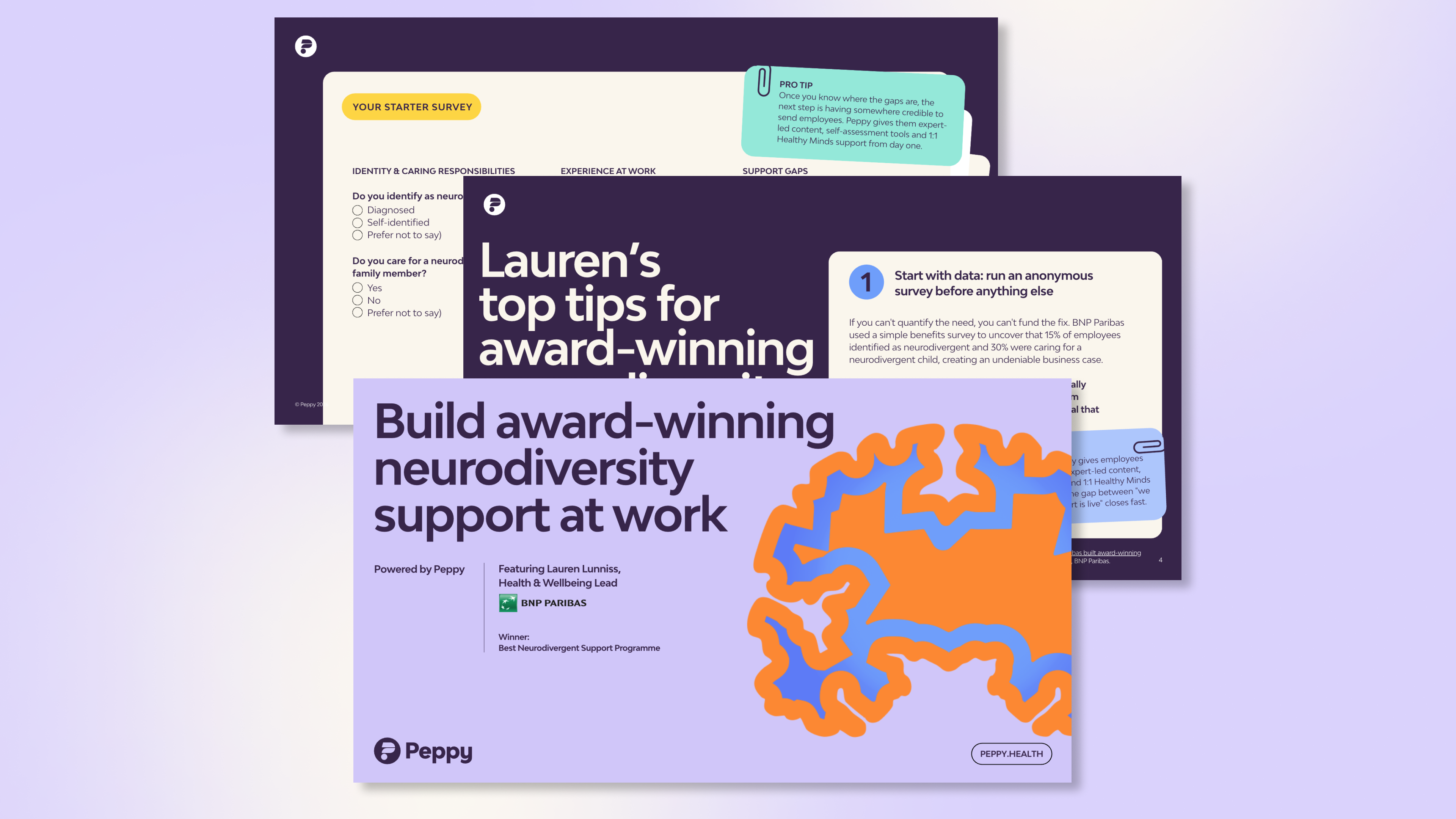
We've turned Lauren's blueprint into a free guide with:
- Her 5 top tips
- Some example survey questions like BNP used (ready to copy)
- How Peppy's neurodiversity support works
How Peppy fits into this
BNP Paribas uses Peppy as part of their award-winning programme.
Peppy's Neurodiversity Support gives employees:
- Expert-curated content on autism, ADHD, dyslexia, dyspraxia, OCD
- Self-screening questionnaires for ADHD and autism
- 1:1 support calls with qualified Healthy Minds practitioners
- Confidential access — no manager disclosure required
All within the Healthy Minds service, which also covers menopause, fertility, pregnancy and parenthood, men's health, and women's health.
Peppy supports employees through every stage of life - from neurodiversity and mental health to menopause, fertility, pregnancy and parenthood, men's health and women's health. One platform, built around the moments that matter most to your people.