-1.png?width=600&height=450&name=Untitled%20design%20(8)-1.png)


Your organisation has a menopause policy. You may even have the beginnings of a Menopause Action Plan. But under the Employment Rights Act (ERA) 2025, the question HR and Benefits leaders are now asking is not whether support exists on paper. It is whether it will hold up when scrutinised.
Voluntary publication of Menopause Action Plans begins in April 2026 for employers with 250 or more employees. Mandatory requirements follow in 2027. The gap between a credible, defensible plan and a thin document is increasingly visible, and the difference often comes down to what specialist benefit you have in place to back it up.
What the ERA 2025 expects from your benefit provision
A menopause policy states intent. A Menopause Action Plan (MAP) requires proof. Under the ERA 2025, employers need to show the practical steps they have taken, how consistently those steps are applied, and what measurable impact they are having.
The Fair Work Agency will be reviewing published plans. Broad commitments without clinical infrastructure behind them will not hold up. What the Act demands is specificity: concrete adjustments, expert clinical access, consistent support across locations and teams, and data to substantiate the plan.
Most generalist Employee Assistance Programmes (EAPs) were not built for this. They lack the menopause-specific clinical depth required to manage complex symptoms, and they rarely generate the kind of outcome data that makes a plan defensible.
The scale of what is at stake
There are approximately 4 million women aged 45 to 60 in work in the UK. This is the core demographic most likely to be experiencing menopause. The data on what happens when they are not supported is clear.
- 67% say menopause negatively affects their work
- 1 in 4 women consider leaving their job because of menopause symptoms
- 1 in 10 have already left the workforce for good, costing businesses around £1.5 billion every year
- Over half have been unable to attend work due to symptoms
- Employment tribunal claims referencing menopause have more than tripled in recent years
These stats represent experienced, senior employees leaving organisations that could not demonstrate adequate support. The ERA 2025 was introduced, in part, to address this. Benefits leaders who have the right specialist provision in place will be significantly better positioned, both legally and in terms of retention.
What a specialist menopause benefit needs to do
When evaluating what to put in place, there are five things a specialist benefit must deliver to satisfy ERA expectations and produce real outcomes.
1. Direct access to certified menopause clinicians
Support must go beyond awareness resources and helplines. Employees need direct, one-to-one access to British Menopause Society (BMS)-certified practitioners who can provide personalised, expert guidance on symptoms, treatment options and workplace adjustments. This is what prevents minor symptoms from becoming absence, performance issues or resignation.
2. Personalised symptom management
Symptoms including brain fog, hot flushes, insomnia and anxiety affect employees differently. A credible benefit provides personalised consultations that help individuals understand their specific experience and request appropriate adjustments. Without this, a plan risks being aspirational rather than actionable under scrutiny.
3. Consistent delivery across your entire workforce
Inconsistency is one of the highest legal risk areas for large organisations. If support depends on which manager an employee has, or which office they work in, the organisation is exposed to discrimination claims. A specialist benefit needs to deliver the same standard of support across every level and location, from the C-suite to the shop floor.
4. Measurable outcomes you can publish
The ERA requires more than stating what is in place. It requires showing those measures are working. Anonymised engagement data, utilisation figures and measurable clinical outcomes are what turn a plan into a credible compliance document. Without this evidence, the plan is difficult to defend.
5. Support from perimenopause through to post-menopause
Legal protection under the ERA begins as soon as symptoms start affecting work. For many women, that happens years before a formal diagnosis, during perimenopause. A benefit that only activates post-diagnosis leaves a significant gap. Early clinical intervention reduces the risk of performance management disputes rooted in undiagnosed perimenopause symptoms.
What Peppy delivers against these requirements
Peppy's menopause support was built specifically to provide the kind of specialist, evidence-based menopause support that holds up under ERA scrutiny.
Specialist clinician access
Employees get direct, one-to-one access to BMS-certified menopause practitioners via chat and 40-minute video consultations through the Peppy app. Check-ins and long-term guidance mean support does not stop after a single appointment.
Outcomes you can evidence
The data Peppy generates is specific and publishable:
- Severe menopause symptoms reduce by 58% within 180 days
- Work impairment drops by 15% within 90 days
- There is a 21% increase in people who never consider taking time off due to symptoms
- Absence rates fall by up to 18% among those who frequently take time off
These outcomes substantiate an ERA disclosure. They demonstrate that your organisation is not just promising support, it is delivering it.
Equal support regardless of role or location
Peppy removes the postcode lottery of support. Every employee, regardless of seniority or location, accesses the same expert-led clinical pathway. Anonymised reporting gives HR and Benefits leaders visibility of engagement and impact across the organisation without compromising individual confidentiality.
Whole-journey clinical care
Peppy supports employees from the earliest perimenopause symptoms through to post-menopause, with holistic support covering mental wellbeing, fitness and nutrition alongside specialist menopause care. No employee is left to manage this alone, and no employer is left without the evidence to show meaningful, ongoing support was provided.
Why acting now matters more than waiting for 2027
Building a credible menopause action plan takes time. Collecting impact data takes months. Organisations that wait until 2027 will start from scratch, under scrutiny, with no outcomes to show.
Voluntary publication begins in April 2026. Employers who implement specialist support now will have a full year of utilisation data, measurable clinical outcomes and a defensible plan before the mandatory requirement arrives. That is a material advantage, both in terms of legal exposure and in retaining senior female talent at the peak of their careers.
For organisations under 250 employees, reasonable adjustment expectations under existing employment law already apply. Implementing specialist menopause support now means being prepared when growth brings the threshold closer.
The question for Benefits leaders right now
The question is not whether to have menopause support. The question is whether what you have can be evidenced, published and defended.
Before committing to any benefit, ask the following:
- Does it provide direct access to BMS-certified menopause clinicians?
- Can it generate anonymised outcome data you can include in an ERA disclosure?
- Does it support employees consistently regardless of their manager or location?
- Does it cover perimenopause, not just diagnosed menopause?
- Does it provide holistic, whole-journey support rather than one-off interventions?
If your current provision cannot answer yes to all of these, there is a gap between where you are and where ERA 2025 expects you to be.
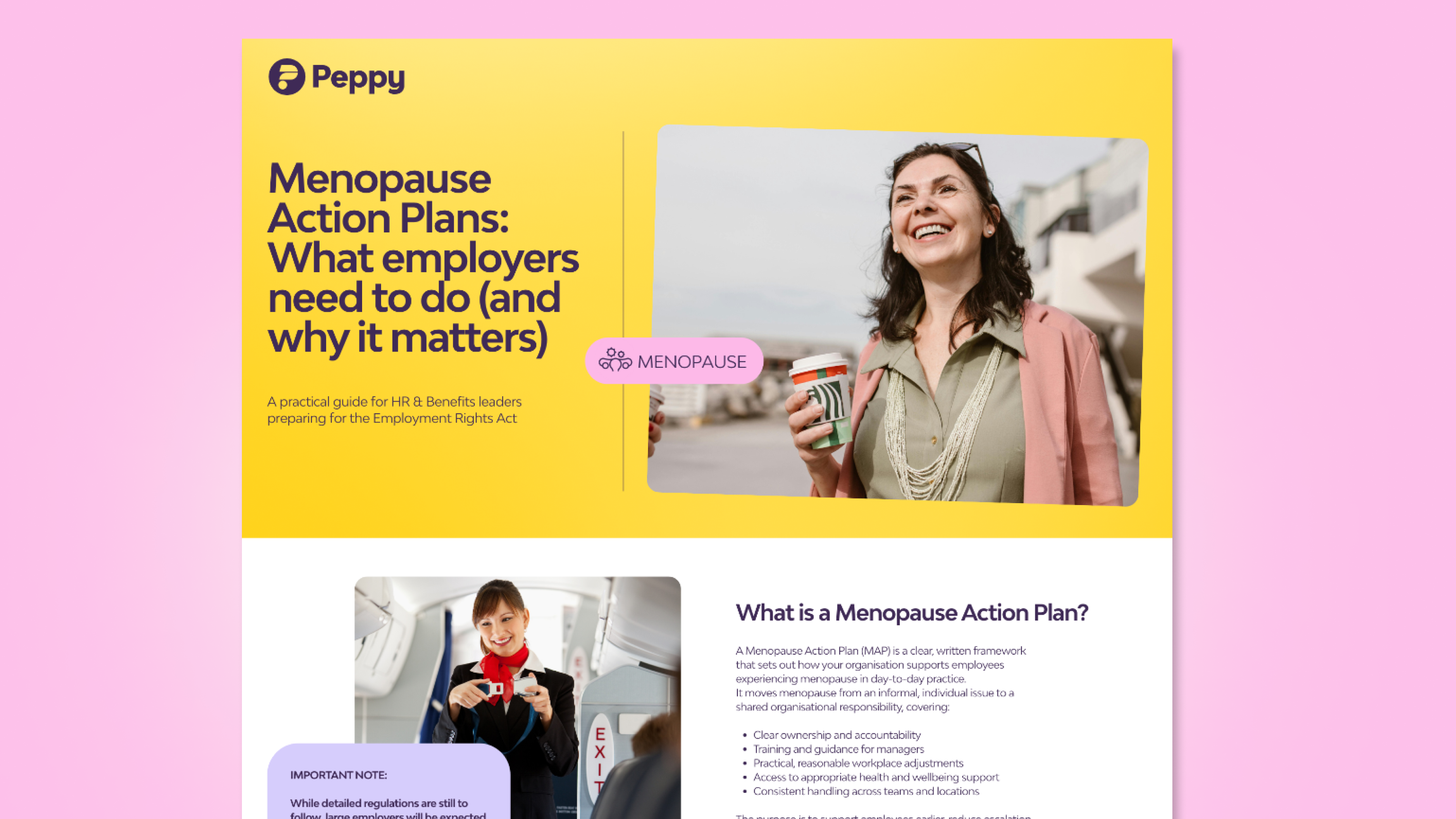
Download Peppy's practical guide to Menopause Action Plans for HR and Benefits leaders. It covers what good looks like under the ERA 2025, the clinical infrastructure required to make a plan defensible, and how to build the internal case for specialist support.