-1.png?width=600&height=450&name=Untitled%20design%20(8)-1.png)


Most employers think they're covered. Most aren't.
Why women's health is now a legal issue for employers
When HR leaders think about legal risk, they think about contracts, redundancy processes and disciplinary procedures. The checklist is long and familiar.
Women's health rarely makes the list.
That's a problem. The legal landscape around women's health at work has shifted significantly, particularly around menopause, but also conditions like endometriosis, PCOS and severe PMS. Employers who haven't caught up are accumulating liability they don't know about.
Does ignoring women's health at work create legal risk?
Yes. And the existing legal framework already applies, even without new legislation.
Under the Equality Act 2010, employees are protected from discrimination on the grounds of sex, age and disability. Menopause symptoms can qualify as a disability under the Act when they are severe and long-lasting enough to affect someone's ability to carry out day-to-day activities. The same applies to conditions like endometriosis.
Employment tribunals have found in favour of employees in menopause-related discrimination cases. Women have won claims for unfair dismissal, sex discrimination and disability discrimination in cases where employers dismissed symptoms as personal problems rather than health conditions warranting reasonable adjustments.
The Equality and Human Rights Commission has published guidance on this. The Women and Equalities Committee has called for greater protections. The direction of travel is clear.
Many organisations are still operating as though none of this applies to them.
What is the business cost of ignoring women's health at work?
Beyond tribunal risk, there is a cost that never shows up on a legal bill but is arguably just as damaging.
One in four women consider leaving work due to menopause. One in ten actually do.
These are often experienced, senior women. People who took decades to develop, who hold institutional knowledge, who mentor others. When they leave, they rarely give the real reason. They cite career change or personal reasons. The fact that they felt unsupported, embarrassed or simply couldn't function without specialist help goes unrecorded.
And this doesn't stop at menopause. Women's health conditions affect employees across every age group:
- Endometriosis affects 1 in 10 women, causing chronic pain that makes regular attendance and concentration genuinely difficult
- PCOS and severe PMS affect mood, energy and cognitive function in ways that directly impact performance
- Perimenopause often begins in a woman's 40s, right when many are in senior or leadership roles
When these conditions go unacknowledged and unsupported, women manage alone. Some push through. Many quietly step back from leadership ambitions. Some leave.
None of this shows up in a risk register. But all of it is happening.
Is an EAP enough to protect employers from women's health-related claims?
This is one of the most common questions Peppy hears from employers. If you have an Employee Assistance Programme, it's reasonable to feel covered.
But EAPs are generalist by design. They are not staffed by clinicians who specialise in gynaecological health, perimenopause or conditions like endometriosis. They cannot offer the kind of ongoing, personalised support that constitutes a genuine reasonable adjustment. They cannot demonstrate that your organisation has taken proactive steps to support employees through documented health conditions.
From a legal standpoint, "we pointed them to the EAP" is not a strong position if a claim reaches tribunal.
What tribunals and regulators look for is evidence that an employer took the matter seriously. That they made reasonable adjustments, provided access to specialist support and created an environment where employees could raise health concerns without fear of stigma or career consequences.
That requires more than a helpline number.
How workplace stigma increases legal exposure
Even where support exists, many women don't use it.
The workplaces most at risk are often the ones where women feel least comfortable disclosing health issues. Consider what it means to tell a line manager that you're struggling to concentrate because of brain fog, or that you need to leave meetings suddenly because of hot flushes. In workplaces that haven't normalised these conversations, disclosure feels like a career risk.
So women say nothing. They underperform quietly. They are managed out, or they leave.
The legal exposure here is compounded by the silence. If an employee never disclosed a health condition, how can you demonstrate that you provided appropriate support? And if the workplace culture actively discouraged disclosure, that itself becomes a relevant factor in any claim.
What does a legally defensible approach to women's health at work look like?
Employers who are genuinely protected share a few characteristics.
They have a documented policy. A menopause policy, and ideally a broader women's health policy, that sets out how the organisation recognises these conditions and what support is available. This document signals intent and creates accountability.
They train managers. Line managers are the first point of contact for most employees. If they lack the knowledge, language and confidence to have these conversations sensitively, no policy will be effective in practice.
They provide access to specialist support. This means clinicians, not generalists, who can provide personalised, evidence-based guidance. Employees need somewhere to turn that is confidential, expert and genuinely useful.
They track and adjust. Reasonable adjustments for conditions like menopause or endometriosis are not a one-off conversation. They need to evolve as symptoms change. Employers who can demonstrate ongoing, documented engagement are in a far stronger legal position.
They create psychological safety. Women need to feel that raising health concerns will not affect how they are perceived or how they progress. This is the softest element, but often the most important one.
How does the Employment Rights Act 2025 affect employer obligations around women's health?
The Employment Rights Act 2025 increases employer obligations across flexible working, redundancy protections and day-one rights. While it does not explicitly legislate on women's health, the broader direction is clear. Employee protections are expanding, expectations are rising and employers who fall behind face increasing scrutiny.
This matters for menopause specifically. The Act's strengthened provisions around flexible working and protection from dismissal make it harder for employers to manage out employees whose performance or attendance has been affected by health conditions, including menopause symptoms, without facing significant legal exposure. Employers without a documented menopause action plan are in a weaker position to demonstrate they took appropriate steps before any performance or absence management process began.
A menopause action plan does not need to be complex. But it does need to exist, be known to managers and be backed by genuine access to specialist support. Without that, the gap between what the law expects and what your organisation actually provides becomes very difficult to defend.
For HR and benefits leaders, the time to act is now. Not because a new rule compels you to, but because the existing framework already does and the cost of inaction is only going up.
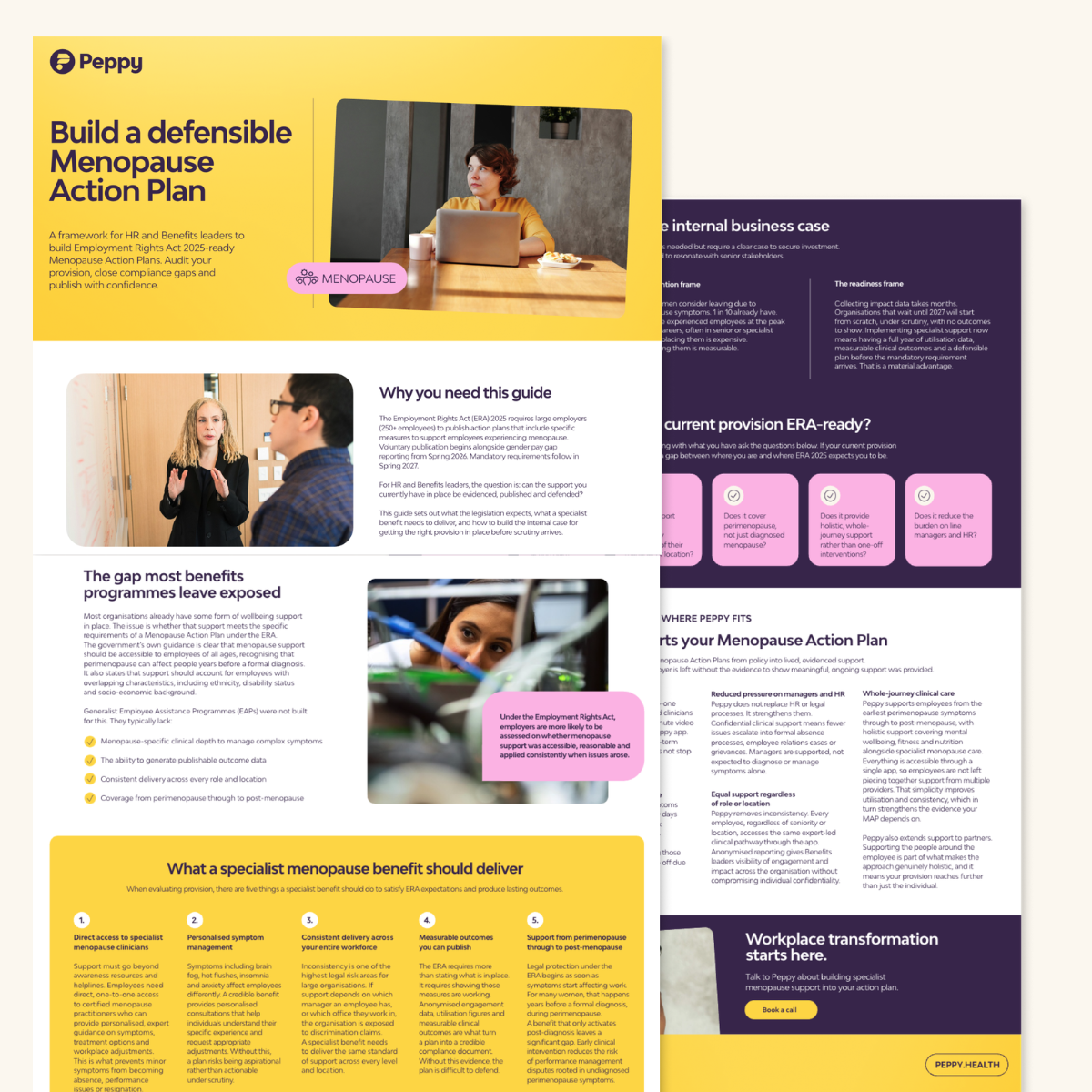
Build a robust and evidence-based Menopause Action Plan
If your organisation does not currently have a documented, actionable plan for supporting employees through menopause, that is the first gap to close. Not because it is a nice thing to do, but because it is a legal and business imperative.
Peppy's guide to building a defensible Menopause Action Plan is a practical resource for HR and benefits leaders who need to move from awareness to action. It covers what a compliant, credible policy looks like, how to make the case internally and what specialist support should actually include.
Peppy connects employees to specialist clinicians through their employer, offering confidential, unlimited access to expert support across menopause, women's health, men's health, fertility and pregnancy and parenthood, all through a simple app. Trusted by 250+ employers supporting over 3 million employees.
Frequently asked questions
Can an employee take an employer to tribunal over menopause symptoms?
Yes. Employment tribunals have upheld claims where menopause symptoms were severe enough to qualify as a disability under the Equality Act 2010 and where employers failed to make reasonable adjustments. Claims have also been brought on grounds of sex and age discrimination.
What counts as a reasonable adjustment for menopause at work?
Reasonable adjustments can include flexible working arrangements, access to a cooler workspace, uniform adjustments, rest breaks, changes to workload during acute symptom periods and access to specialist health support. What is reasonable depends on the individual's circumstances and the employer's size and resources.
Is a menopause policy a legal requirement in the UK?
There is currently no standalone legal requirement for a menopause policy in the UK. However, the Equality Act 2010 already creates obligations that a menopause policy helps an employer meet and demonstrate. The EHRC guidance and growing tribunal precedents make having a documented policy increasingly important from a risk management perspective.
Do women's health conditions other than menopause create legal risk for employers?
Yes. Endometriosis, PCOS, severe PMS and other gynaecological conditions can qualify as disabilities under the Equality Act if they have a substantial and long-term adverse effect on normal day-to-day activities. Employers who fail to make reasonable adjustments or who treat affected employees less favourably may face discrimination claims.