-1.png?width=600&height=450&name=Untitled%20design%20(8)-1.png)


Neurodiversity Celebration Week is the right moment to ask an honest question: do your neurodivergent employees have meaningful support, or just a policy that says they do?
Most organisations have a neurodiversity policy. Far fewer have neurodiversity support. That distinction matters and neurodivergent employees know the difference.
1 in 5 employees are neurodivergent. Only 37% feel their organisation provides meaningful support. Closing that gap is one of the clearest opportunities available to HR leaders looking to improve retention, performance and culture.
The scale is larger than your data shows
Between 15 and 20% of the workforce are undiagnosed. They are not invisible because they don't exist. They are invisible because the system hasn't caught up with them.
National Health Service diagnostic wait times are now three to five years in some areas. Employees who have already sought a diagnosis may be managing meetings, deadlines and performance reviews without adjustments and without support. Organisations that build support before the diagnosis arrives are the ones that retain that talent.
Three outcomes that improve when you get this right
Absence reduces. Employees with the right support are less likely to take stress-related leave. There is also a carer dimension most organisations are not tracking. BNP Paribas discovered that 30% of their employees were caring for a neurodivergent child - a hidden absence driver that rarely appears in workforce data.
Attrition falls. Supported neurodivergent employees stay and contribute. Unsupported ones disengage quietly. As Jo Crooks, Healthy Minds Practitioner at Peppy, puts it: "When neurodivergent employees feel supported, they stay, contribute and thrive. Access to specialist support, like the support provided by Peppy, gives reassurance, validation, and self-understanding, helping individuals to take control, know what they need, and stay motivated to continue giving their best"
Performance improves. Neurodivergent employees with the right adjustments bring genuine strengths to their roles. The challenge has never been capability. It has been access to the tools and environment that allow those strengths to show up.
The manager confidence problem
Managers are not clinicians. Without basic awareness and practical tools, they become an unintentional barrier between what the organisation has committed to and what the employee actually experiences.
BNP Paribas addressed this directly. Their investment in manager training produced a 97% increase in manager confidence. That result came not from turning managers into neurodiversity experts, but from giving them awareness, tools and a clear structure to work within.
What it looks like when it works
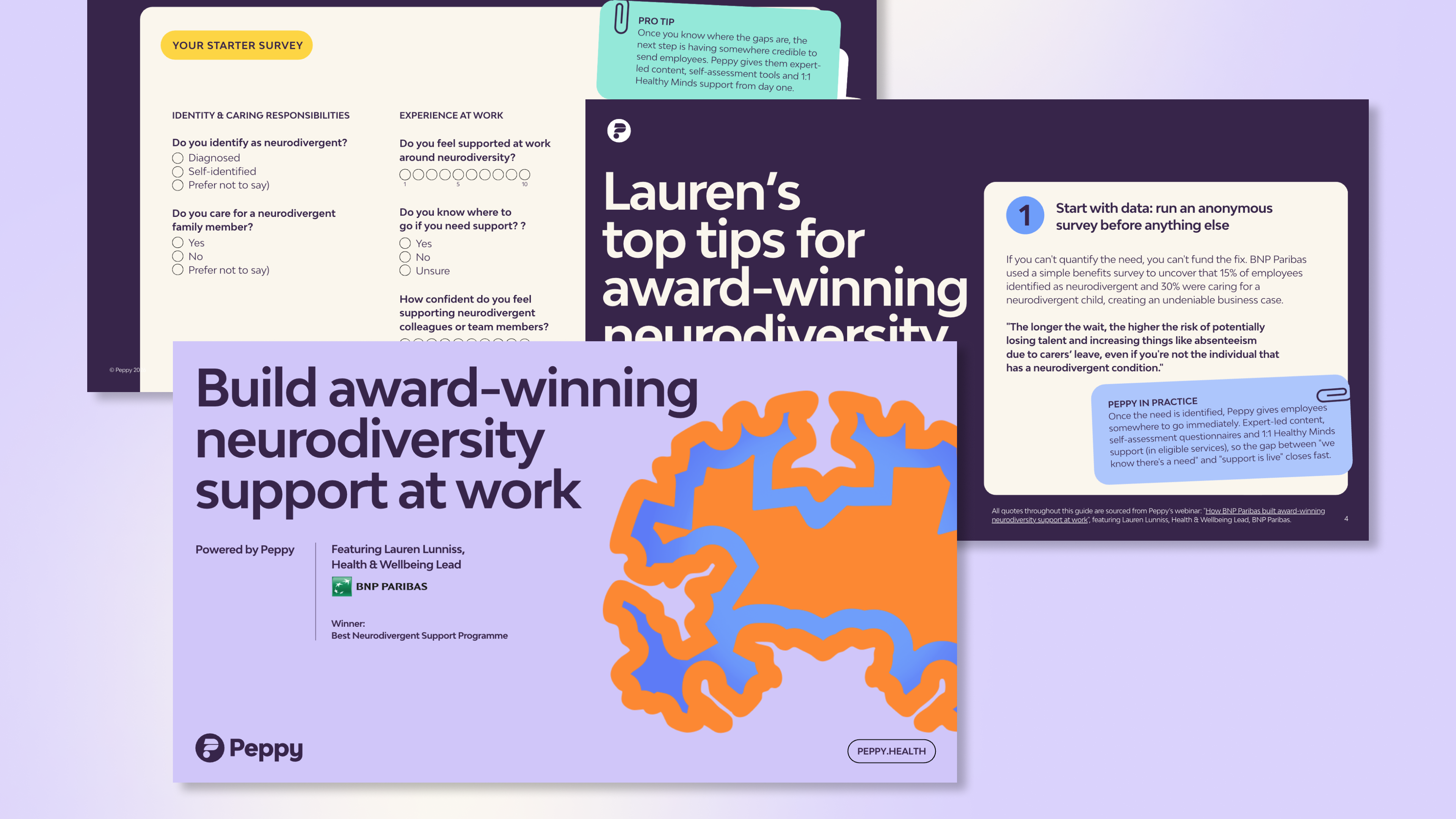
BNP Paribas moved from awareness to action and won the Best Neurodivergent Support Programme award. Over 500 employees used the diagnostic pathway in year one. Neurodivergent employees rated their likelihood of staying at 8.2 out of 10.
As Lauren Lunniss, Health and Wellbeing Lead at BNP Paribas, put it: "A problem that began as a public health bottleneck has become a culture cornerstone."
The steps they took to get there are covered in this guide.
How Peppy closes the gap

Peppy's Neurodiversity Support Programme, within the Healthy Minds service, gives employees:
- Expert-curated content covering autism, ADHD (attention deficit hyperactivity disorder), OCD (obsessive compulsive disorder) and more
- Evidence-based ADHD and autism screening questionnaires
- 1:1 support calls with qualified Healthy Minds practitioners
- Confidential access - no manager disclosure required
Employees can access support without disclosing to colleagues. For the 15 to 20% who are undiagnosed and those waiting years for an NHS appointment, that access is significant.
Frequently asked questions
What is neurodiversity in the workplace?
Neurodiversity refers to the natural variation in how human brains work. Neurodivergent conditions include ADHD, autism, dyslexia, dyspraxia and OCD, among others. 1 in 5 employees are neurodivergent, making it a workforce issue rather than a niche one.
Why does neurodiversity support matter for employers?
Unsupported neurodivergent employees are more likely to disengage, take stress-related absence or leave. Employers who provide structured support see measurable improvements in retention, manager confidence and workplace culture.
What is the difference between a neurodiversity policy and neurodiversity support?
A policy documents an organisation's commitment. Support delivers practical help - diagnosis access, post-diagnostic care, manager training and confidential resources. Without the latter, a policy has limited impact on the employee experience.
Why are NHS waiting times relevant to employers?
NHS diagnostic wait times are three to five years in some areas. Employees seeking a diagnosis may wait years before receiving one, meaning they are navigating work without adjustments or clarity. Employer-funded support can bridge that gap.
What is Neurodiversity Celebration Week?
Neurodiversity Celebration Week is an annual initiative that encourages organisations to recognise and celebrate neurodivergent talent. It is also a practical prompt for HR leaders to assess whether existing support matches the visible commitment.
How can HR leaders build a business case for neurodiversity support?
Start with data. An anonymous employee survey asking about neurodivergent identity, caring responsibilities and experience at work gives you the scale of the need and the gaps to address. BNP Paribas used this approach to uncover that 15% of employees identified as neurodivergent and 30% were caring for a neurodivergent child - data that built an undeniable case for investment.