-1.png?width=600&height=450&name=Untitled%20design%20(8)-1.png)


The Employment Rights Act (ERA) 2025 has moved menopause from a wellbeing conversation to a compliance requirement. Large employers with 250 or more employees must now publish Menopause Action Plans (MAPs) alongside gender pay gap data. Voluntary submissions begin from now, with mandatory requirements to follow in Spring 2027.
For HR and Benefits leaders, this introduces the question: can the support you currently provide be evidenced, published and defended?
What the legislation requires
A menopause policy states intent. A Menopause Action Plan requires proof.
Under the ERA, employers must create, submit and publish their action plan on the gender pay gap service. Published plans will be publicly visible. The Fair Work Agency will be reviewing them.
Employers must select a minimum of two actions:
- At least one must address the gender pay gap
- At least one must support employees experiencing menopause
The government has published 18 evidence-informed actions. Many relate directly to menopause, including:
- Training managers to support employees experiencing menopause
- Offering occupational health advice
- Setting up menopause support groups and networks
- Conducting menopause risk assessments
- Reviewing policies and procedures to meet the needs of affected employees
Each action selected must be classified as new, in progress, or already embedded. At least two actions across the full plan must be new or in progress.
Broad commitments without clinical infrastructure behind them will not hold up. Specificity is what the Act demands: concrete adjustments, expert clinical access, consistent support across teams and locations, and data to substantiate the plan.
Why this matters commercially
There are approximately four million women aged 45 to 60 currently in the UK workforce. These are experienced employees, often in senior or specialist roles.
The data makes the business case difficult to ignore:
- 67% of women say menopause negatively affects their work
- Over half have been unable to attend work due to symptoms, with 10% leaving for good, costing businesses around £1.5 billion every year
- 1 in 4 women consider leaving their job because of menopause symptoms
- Employment tribunal claims referencing menopause have more than tripled over the past few years
Replacing senior employees is expensive. Defending tribunal claims is expensive. Losing institutional knowledge and leadership capability because of unmanaged symptoms is a cost most organisations never measure, but always feel.
The hidden cost of silence
Over two in five UK employees are uncomfortable talking to anyone at work about menopause. That statistic should concern every Benefits leader because it means the problem is larger than reported absence or formal complaints suggest.
When people do not feel able to raise health concerns, they find other ways to cope. They reduce their hours. They step back from promotions. They disengage. Eventually, they leave. None of those outcomes appear in a menopause-specific metric, but they all show up in attrition data and leadership pipeline gaps.
Stigma is a cultural issue and a business risk. It compounds over time.
Where most benefits programmes fall short
Most organisations already have some form of wellbeing support. The question is whether that support meets the specific requirements of a MAP under the ERA.
Generalist Employee Assistance Programmes (EAPs) were not built for this purpose. They typically lack:
- Menopause-specific clinical depth to manage complex symptoms
- The ability to generate publishable outcome data
- Consistent delivery across every role and location
- Coverage from perimenopause through to post-menopause
The government's own guidance is clear that menopause support should be accessible to employees of all ages, recognising that perimenopause can affect people years before a formal diagnosis. Support should also account for employees with overlapping characteristics, including ethnicity, disability status, and socio-economic background.
If your current provision cannot serve someone in the early stages of perimenopause with the same quality of support as someone post-diagnosis, regardless of their location or manager, there is a gap between where you are and where the ERA expects you to be.
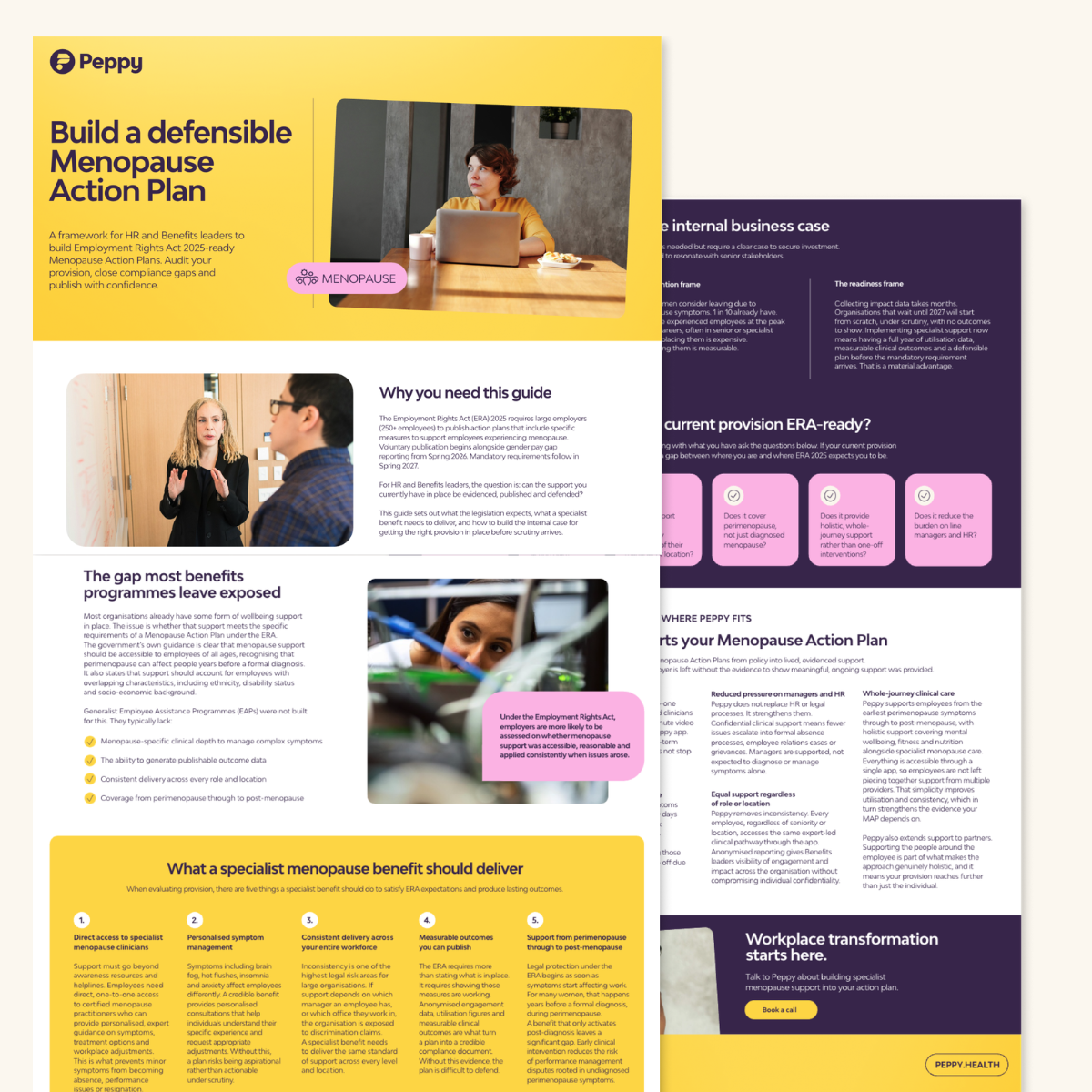
Five things specialist provision should deliver
When evaluating whether your menopause support is fit for purpose under the ERA, there are five core features to assess.
1. Direct access to specialist clinicians
Support must go beyond awareness resources and helplines. Employees need one-to-one access to certified menopause practitioners who can provide personalised guidance on symptoms, treatment options, and workplace adjustments. This is what prevents minor symptoms from becoming absence, performance issues, or resignation.
2. Personalised symptom management
Symptoms including brain fog, hot flushes, insomnia, and anxiety affect employees differently. Credible provision offers personalised consultations that help individuals understand their specific experience and request appropriate adjustments. Without this, a plan risks being aspirational rather than actionable under scrutiny.
3. Consistent delivery across the entire workforce
Inconsistency is one of the highest legal risk areas for large organisations. If support depends on which manager an employee has, or which office they work in, the organisation is exposed to discrimination claims. Specialist provision needs to deliver the same standard of support across every level and location.
4. Measurable outcomes that can be published
The ERA requires more than stating what is in place. It requires showing those measures are working. Anonymised engagement data, utilisation figures, and measurable clinical outcomes are what turn a plan into a credible compliance document. Without evidence, the plan is difficult to defend.
5. Coverage from perimenopause through to post-menopause
Legal protection under the ERA begins as soon as symptoms start affecting work. For many people, that happens years before formal diagnosis. Provision that only activates post-diagnosis leaves a significant gap and creates risk around performance management disputes rooted in undiagnosed perimenopause symptoms.
Building the internal business case
Benefits leaders often know what is needed but require a clear case to secure investment. Three frames tend to work with senior stakeholders.
The legal frame: Published MAPs will be publicly visible and reviewed by the Fair Work Agency. Tribunal claims referencing menopause have tripled. The cost of defending a single claim far exceeds the cost of specialist provision.
The retention frame: 1 in 4 women consider leaving due to menopause symptoms. 1 in 10 already have. These are employees at the peak of their careers. Supporting them is measurable. Losing them is avoidable.
The readiness frame: Collecting impact data takes months. Organisations that wait until 2027 will start from scratch, under scrutiny, with no outcomes to show. Starting now means having a full year of utilisation data and measurable clinical outcomes before the mandatory requirement arrives. That is time you cannot recover later.
The reputation frame: Published MAPs are publicly visible. Employees and candidates will compare them. Organisations doing nothing will stand out... negatively. Employers who lag behind peers will face external scrutiny and internal trust issues, before regulators even get involved.
A checklist for Benefits leaders
Before committing to any provision, or continuing with what you have, these are the questions worth asking:
- Does it provide direct access to certified menopause clinicians?
- Does it cover perimenopause, not just diagnosed menopause?
- Does it support employees consistently regardless of their manager or location?
- Does it provide holistic, whole-journey support rather than one-off interventions?
- Can it generate anonymised outcome data you can include in a published ERA action plan?
- Does it reduce the burden on line managers and HR?
Answering no to any of these points to a gap between your current provision and what the legislation expects.
What happens next
Spring 2026 is when voluntary submissions open. Mandatory requirements are expected from Spring 2027. The organisations that will be in the strongest position are those that start now, building evidence, identifying gaps and putting specialist support in place before the scrutiny begins.
Menopause support is now becoming a published, public-facing compliance document. Treat it accordingly.
For a step-by-step framework to audit your current provision, build your internal business case, and prepare a defensible Menopause Action Plan under the ERA, download Peppy's guide for HR and Benefits leaders.